 Back to Blog
How a Leading Financial Institution Uses Semantic Analysis to Eliminate False Positives
During large-scale cyber security attack-and-defense exercises, as well as routine daily operations, a leading global financial institution faced a growing security dilemma. While its production systems were heavily fortified, its external-facing development and testing environments increasingly became prime focal points for sophisticated threat actors attempting to breach the corporate perimeter.
The bank’s Software Development Center managed an extensive array of development and testing sites that were publicly launched and exposed to the Internet. These assets processed a complex mix of HTTP and HTTPS traffic. To fortify its security posture without disrupting rapid software release cycles, the institution required a highly specialized Web application layer defense capable of scaling across all public-facing development and testing sites. However, the security operations team faced strict constraints: they had limited personnel bandwidth and could not afford to waste time triaging excessive noise from invalid alerts. The institution needed a high-fidelity, highly available security architecture that could accurately flag critical security incidents while providing continuous operational support.
Why Do Legacy Egress Protections Fail to Safeguard Dynamic Dev & Test Zones?
In a modern financial software development lifecycle, application environments change rapidly, rendering traditional signature-based Intrusion Prevention Systems (IPS) and legacy Web Application Firewalls insufficient. Legacy egress protections struggle to maintain pace with the unique characteristics of a dynamic testing zone, creating several operational friction points:
| Industry Security Challenge | Limitations of Standard Inline & Signature Protections | Operational Impact on Financial Institutions |
| High Volume of False Positives | Traditional regex-based pattern matching triggers massive alert noise on harmless, non-standard testing code. | Overwhelms security teams with limited staff capacity, leading to critical alert fatigue. |
| Lack of Protocol-Wide Coverage | Older security tools struggle to inspect mixed protocol streams simultaneously and uniformly. | Leaves blind spots across newly deployed HTTP and HTTPS testing endpoints. |
| Operational Maintenance Overhead | Manual rule tuning cannot keep up with code changes inherent to rapid development cycles. | Leaves exposed environments vulnerable during critical windows like national attack-and-defense exercises. |
| Siloed Incident Notification | Legacy systems require manual log reviews to identify severe application-layer compromises. | Delays emergency incident response times during high-risk application breaches. |

How Does CyberServal WAF Deliver Precise, High-Availability Web Security?
To address these deep-seated vulnerabilities, the financial institution overhauled its application egress security by deploying CyberServal WAF at the Internet egress of the Software Development Center’s network. The deployment introduced an advanced architectural framework designed for precision, resilience, and operational efficiency.
Advanced Semantic Analysis for Precise Attack Detection
Rather than relying on brittle, easily bypassed regular expressions (regex) that generate excessive alert noise, CyberServal web application firewall solution utilizes intelligent semantic analysis technology to evaluate HTTP and HTTPS traffic. By parsing the underlying execution logic of web requests, the engine distinguishes between actual malicious payloads and benign, non-standard test scripts. This delivers exceptional detection accuracy with remarkably few false-positive noise logs, allowing the bank’s security personnel to focus exclusively on true security incidents.
👉 From Rule-Based WAF to Semantic Intelligence WAF
High-Availability Active-Standby Architecture via Transparent Proxy
To ensure continuous security enforcement and zero business disruption, the solution is deployed using a transparent proxy model. It is implemented in a dual-node redundant, active-standby topology:
Transparent Integration: The WAF intercepts traffic inline without requiring complex changes to DNS routing or application-side configurations across the development and testing zone.
Instant Failover Mechanism: Stateful heartbeat monitoring connects the active and standby nodes. If the primary appliance encounters a hardware or network anomaly, the standby unit immediately takes over traffic inspection, guaranteeing uninterrupted uptime for all live testing sites.
Automated Emergency Alerting and Managed Security Operations
The platform bridges the gap between threat detection and rapid incident response through native integrations and structured periodic maintenance:
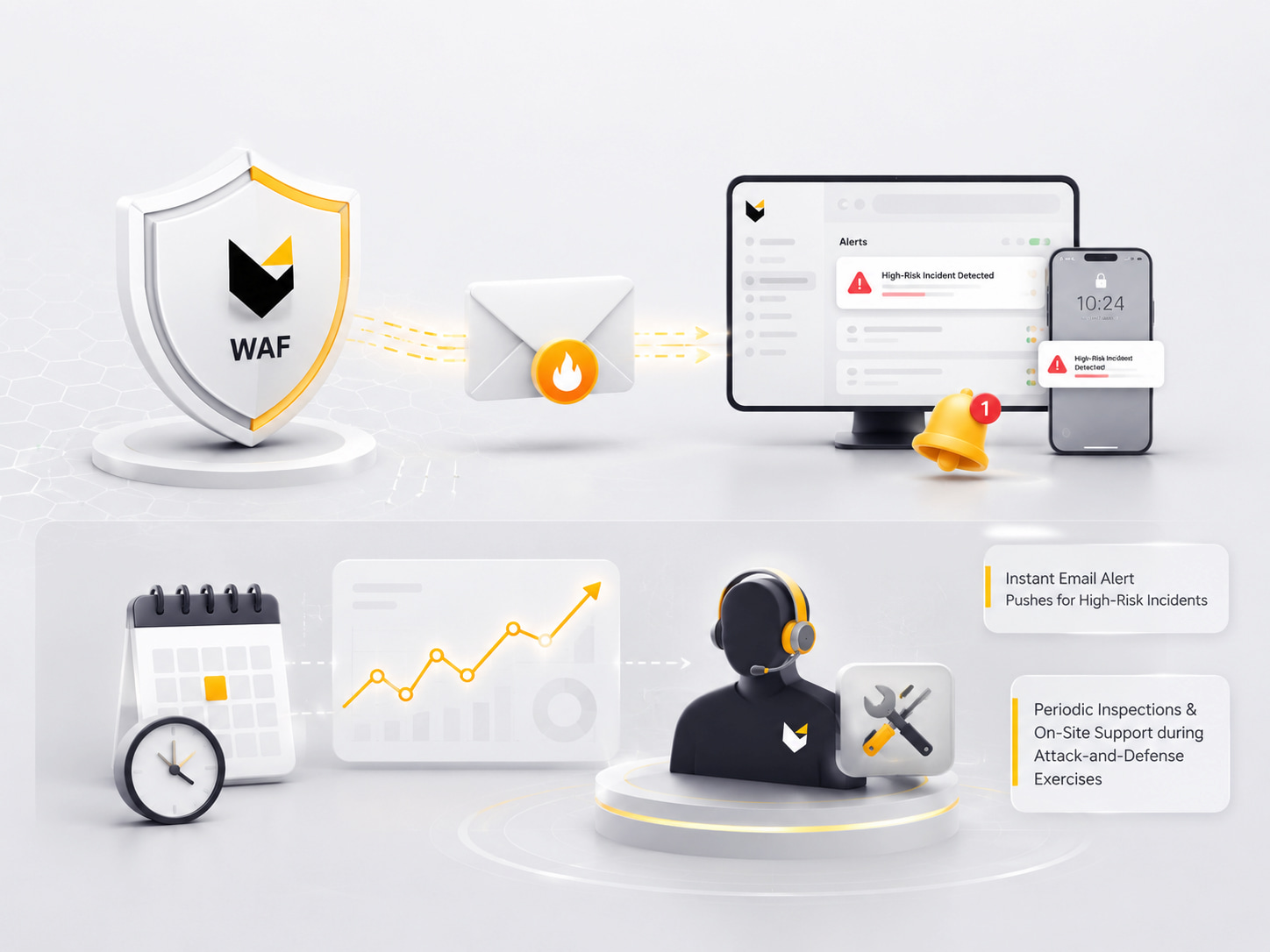
Automated Email Alerting: When high-risk security incidents are detected, CyberServal WAF interfaces directly with the bank's enterprise email system, instantly pushing critical alerts to administrators to streamline response triage.
Periodic Inspections & Expert Support: CyberServal provides regular inspection services to analyze trends in WAF alert logs and evaluate the soundness of policy configurations. Furthermore, during high-stakes attack-and-defense exercises, on-site expert support is delivered to dynamically optimize protection policies and guarantee the robust defense of core business systems.
👉 [Download CyberServal WAF Whitepaper]
Enhancing Financial Security Assurance with Targeted Reinforcement
The strategic integration of CyberServal WAF provided the global financial institution with a resilient, low-maintenance security perimeter tailored to its software innovation pipelines:
Targeted Reinforcement: The solution rapidly deployed and went live within a short operational timeframe, establishing a robust layer of Web application security on top of the bank’s existing network IPS.
Optimized Resource Allocation: By filtering out invalid alerts and providing a clean, low-noise dashboard, the solution significantly enhanced the operational efficiency of security personnel working under limited staff capacity.
Validated Compliance & Resilience: Through a combination of accurate semantic detection, high-availability architecture, and on-site expert tuning, the bank successfully validated its systemic resilience during rigorous, large-scale cyber attack-and-defense exercises.
- 👉 [Book a Demo]