

 Back to Blog
How a Mega-Bank Lowered Operational Risk via a Centralized WAF Platform
As financial services rapidly digitize, a premier global financial institution, operating extensive business clusters including consumer portals, mobile banking applications, branch-specific systems, and AI-driven financial intelligence modules, faced unprecedented security pressures on its production web applications. Operating across multiple international jurisdictions and heavily distributed branch infrastructures, the institution required a highly resilient defense mechanism.
To sustain service continuity and rigorous compliance, the institution defined a set of strict, non-negotiable operational imperatives:
High-Precision Detection: The security layer had to accurately scrutinize high-volume, multi-protocol web traffic without introducing latency or blind spots.
Zero-Friction Deployment: Security measures needed to be implemented rapidly across all production environments without altering the pre-existing network topology or disrupting live transactions.
Signal Noise Reduction: The security team demanded a drastic reduction in both false negatives and false positives to prevent operational fatigue and avoid blocking legitimate financial traffic.
Centralized Orchestration: Managing numerous web application firewall instances independently across disparate environments was unsustainable; the architecture required unified, centralized policy governance.

Why Do Traditional Web Security Defenses Fail in Complex Financial Environments?
The financial sector operates under highly demanding regulatory frameworks and zero-downtime SLA requirements. However, traditional signature-based web security solutions consistently create operational bottlenecks when deployed against modern, dynamic exploit vectors:
| Industry Common Pain Points | Limitations of Legacy Signature-Based WAFs |
| High False Positive Rates Interrupting Transactions | Regular expression (Regex) matching cannot differentiate between complex, legitimate financial data payloads and malicious code strings, leading to business disruption. |
| Vulnerability to Evasion & Zero-Day Exploits | Attackers routinely bypass traditional defenses using encoding obfuscation, nested serialization, and logical business vulnerabilities before public signatures exist. |
| Intrusive Deployment Risks & Single Points of Failure | Traditional inline proxy architectures require modifying existing DNS configurations, IP routing, or load balancer topologies, introducing significant deployment risk and potential downtime. |
| Operational Silos & Fragmented Policy Enforcement | Deploying standalone WAF units across diverse business zones creates fragmented rule bases, inconsistent security baselines, and high maintenance overhead. |
How Does CyberServal WAF Leverage Semantic Analysis and Transparent Bridging for Robust Defense?
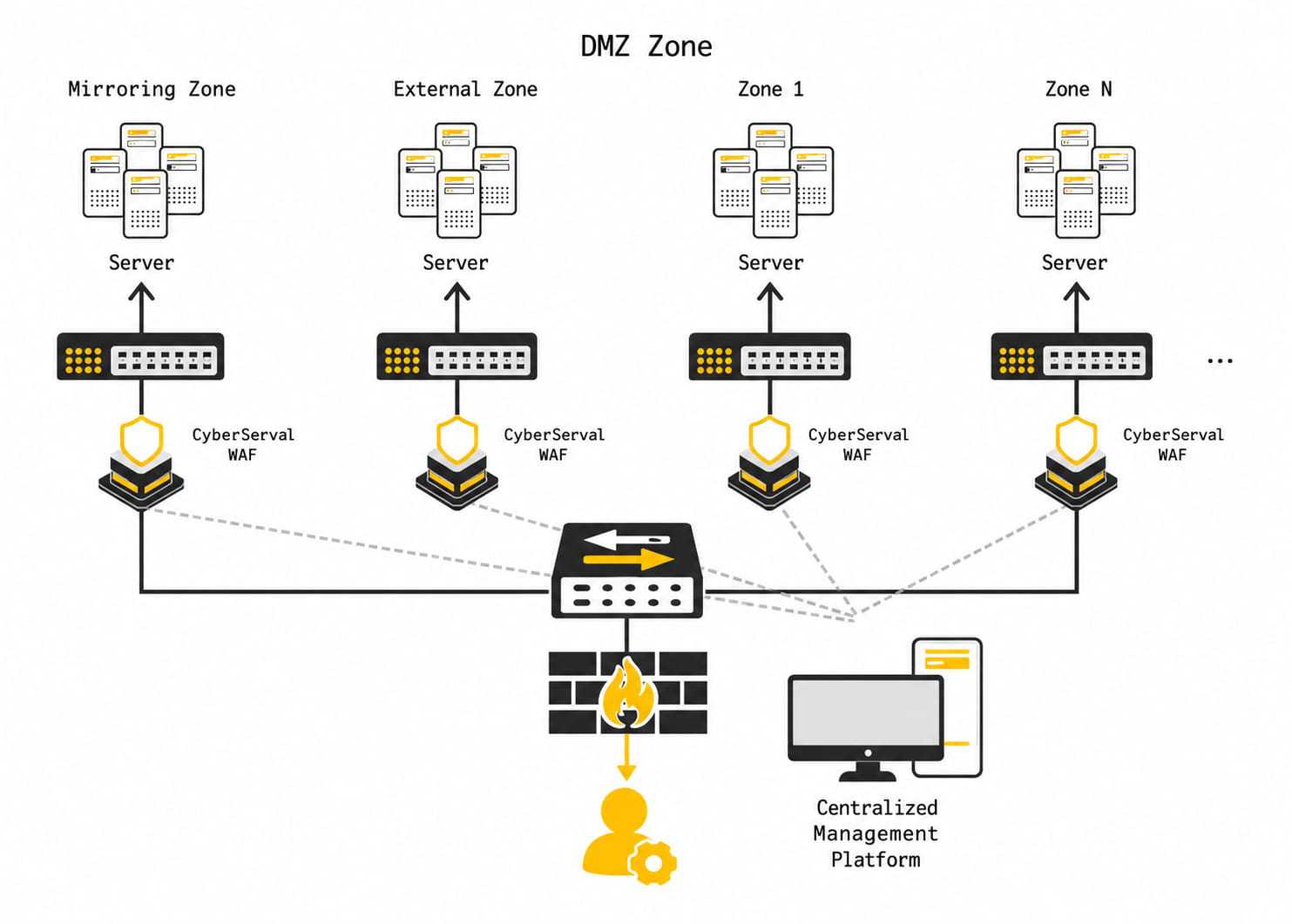
To address these architectural vulnerabilities, the institution implemented a customized CyberServal NGWAF deployment engineered around a Centralized Management Platform combined with a Transparent Bridge Cluster.
Core Engine: Compiler-Based Intelligent Semantic Analysis
CyberServal WAF replaces brittle regular expression matching with an intelligent semantic analysis engine built on native compiler principles.
- The Underlying Logic: Instead of searching for predefined text strings, the engine passes incoming HTTP payloads through an advanced lexer and parser to tokenize the input and construct an Abstract Syntax Tree (AST).
- Concrete Defensive Advantages: By analyzing the execution logic within the AST, the engine determines the true intent of the request, identifying SQL Injection (SQLi), Cross-Site Scripting (XSS), and Remote Code Execution (RCE) regardless of the encoding, obfuscation, or nesting techniques applied. This approach reduces the reliance on constant signature updates and enables the proactive mitigation of zero-day threats while driving false positive rates down.
Deployment Topology: Non-Intrusive Transparent Bridge
- Rapid Integration: CyberServal WAF nodes were deployed inline using a transparent bridge configuration. This allowed the institution to filter traffic at the network layer without modifying application IP addresses, switching infrastructure, or DNS routing.
- Fail-Safe Redundancy: To ensure uninterrupted financial services, the transparent bridge hardware includes a dedicated, automated bypass circuit breaker. In the event of a severe software exception or power loss, the system instantly reverts to a bypass state, preventing any disruption to live business traffic.
Management Architecture: Centralized Governance & Multi-Zone Layering
- Unified Orchestration: The centralized management module acts as a single point of control, handles global policy synchronization, distributes real-time threat intelligence, and deploys hot patches across all active WAF nodes simultaneously.
- Layered Perimeter Defense: The infrastructure was partitioned into distinct mirror, external, and internal zones. CyberServal WAF ingested production mirror traffic alongside inline filtering to perform deep security modeling and retroactive anomaly analysis, establishing a unified security baseline across the entire enterprise.
- 👉 Download CyberServal WAF Whitepaper
Maximizing Security ROI and Driving Operational Resilience
By deploying the CyberServal WAF centralized management architecture, the financial institution significantly strengthened its application security foundation and rapidly achieved production readiness. Powered by a compiler-based semantic analysis engine, the solution substantially reduced false positives compared with traditional regex-based detection methods while enhancing the capability to identify sophisticated zero-day variants and evolving threats. Meanwhile, centralized policy orchestration streamlined multi-node operations, minimized management complexity, and enabled a highly scalable, compliant, and resilient security posture tailored for high-throughput financial environments.