 Back to Blog
Secure Your Hybrid Cloud with CyberSeval CWPP
The shift to hybrid cloud was supposed to offer the best of both worlds: the control of private infrastructure with the scalability of the public cloud. However, for many organizations, this transition has created a "security vacuum." As workloads migrate between virtual machines (VMs), IDC environments, and containers, security teams are finding it increasingly difficult to answer a fundamental question: Do we actually know what is running in our environment?
If you are managing a complex sprawl of assets across multiple clouds, the risks are no longer just outside the perimeter—they are hidden within the very fabric of your infrastructure.
The Invisible Threat: The Real Cost of Missing Hybrid Cloud Asset Visibility
In a hybrid cloud environment, what you can’t see will eventually hurt you. Traditional security tools were built for a static world where servers stayed put and IP addresses rarely changed. Today, workloads are fluid.
The "Real Cost" of visibility gaps manifests in three critical ways:
- The Shadow Asset Problem: Unmanaged instances, forgotten testing environments, and "zombie" containers become the perfect entry points for attackers. Without a unified asset inventory, these assets go unpatched and unmonitored.
- Delayed Incident Response: When a breach occurs, the first step is identification. If your security team spends hours trying to figure out which VPC or container cluster an IP belongs to, the attacker has already achieved persistence.
- Compliance Friction: Regulatory frameworks require a clear mapping of data flow and asset ownership. Missing visibility leads to failed audits and significant legal liability.
True Cloud Workload Protection (CWPP) begins with asset governance. It’s not just about blocking threats; it’s about building a real-time, event-driven map of every process, account, and port across your entire hybrid estate.
7 Critical Blind Spots in Container Security You Can’t Ignore
Containers have revolutionized deployment, but they have also created unique security challenges that traditional host-based tools simply aren't equipped to handle.
To secure a containerized environment, you must address these seven blind spots:
- Ephemeral Nature: Containers live for minutes or even seconds. If your security tool relies on periodic scans, it will miss threats that exist only during a container's short lifecycle.
- Image Vulnerabilities: Deploying a container from an unverified or outdated image can bake vulnerabilities directly into your production environment.
- Container Breakouts: A malicious process within a container attempting to access the host kernel is a "red alert" scenario that requires sub-second detection.
- East-West Traffic: Most attacks move laterally between containers. If you are only monitoring the "North-South" (inbound/outbound) traffic, you are blind to internal movement.
- Shared Kernel Risks: Unlike VMs, containers share the host OS kernel. One compromised container can potentially compromise the entire node.
- Misconfigurations: Over-privileged containers (running as root) are the most common cause of cloud breaches.
- Runtime Visibility: Knowing what is inside the "black box" of a running container—what commands are being executed and what files are being modified—is essential for stopping active attacks.
CWPP vs. Legacy Host Security: The Essential Comparison Matrix
Many enterprises attempt to protect their hybrid cloud using legacy Endpoint Detection and Response (EDR) or Antivirus (AV) tools. While effective for laptops, these tools often fail in the data center.
| Feature | Legacy Host Security (AV/EDR) | Modern CWPP (Lightweight Agent) |
| Resource Overhead | High (5% - 20% CPU spikes) | Extremely Low (< 2% CPU) |
| Container Awareness | Limited or non-existent | Deep integration (K8s/Docker) |
| Detection Speed | Minutes (Log-based) | Seconds (Event-driven) |
| Deployment | Heavyweight installers | Auto-scaling friendly Agents |
| Asset Mapping | Static IP-based | Dynamic, process-centric |
| Focus | User behavior/Malware | Server workloads/Runtime integrity The most significant difference lies in performance. In a production environment, a security tool that consumes 10% of your CPU is effectively a self-inflicted Denial of Service (DoS) attack. A modern CWPP must be "invisible" to the system while remaining "omniscient" regarding security events. |
1-Second Detection for Modern Threats
Detecting a threat is one thing; stopping it before data is exfiltrated is another. In the world of cloud security, the "Golden Hour" of response has shrunk to the "Golden Minute."
Our cloud workload protection solutions are engineered for high-velocity environments where every millisecond counts. By utilizing a lightweight agent that consumes less than 2% CPU and under 80MB of RAM, we ensure that security never throttles your business operations.
But speed isn't just about performance—it's about detection:
- 1-Second Reverse Shell Identification: Reverse shells are the calling cards of successful intrusions. Our system identifies and alerts on unauthorized shell connections in under a second.
- 10-Second Webshell Locking: Webshells allow attackers to maintain persistent access to your web servers. We identify and lock down these malicious scripts within 10 seconds of activity.
By correlating these events with the ATT&CK framework, we provide security teams with a deep understanding of the attacker's tactics, from initial access to lateral movement.
Bridging the Compliance Gap in a Multi-Cloud World
Whether you are navigating local regulations like "Equivalence Protection" or global standards like SOC2 and PCI-DSS, compliance in a hybrid cloud is a moving target.
The challenge isn't just having security; it's proving it. A robust CWPP solves this by providing:
- Automated Compliance Baselines: Automatically scan your VMs and containers against industry-standard benchmarks (CIS, etc.) to identify misconfigurations.
- Vulnerability Management: Prioritize risks based on real-world exploitability and threat intelligence, rather than just a long list of CVEs.
- Audit-Ready Logging: Maintain a clear, tamper-proof record of every administrative action, process start, and network connection across your infrastructure.
By integrating asset governance, intrusion detection, and compliance into a single platform, you move from a reactive "firefighting" stance to a proactive security posture.
Securing Your Digital Future
As hybrid cloud environments become the standard, the "old way" of doing security is no longer sustainable. You cannot protect what you cannot see, and you cannot afford to trade system performance for safety. A modern Cloud Workload Protection Platform (CWPP) provides the visibility, speed, and efficiency required to defend today’s dynamic workloads.
By focusing on a lightweight, event-driven architecture, you can close the seven blind spots of container security and ensure that your infrastructure is resilient against even the most sophisticated intrusions.
Ready to see what’s actually happening inside your servers?
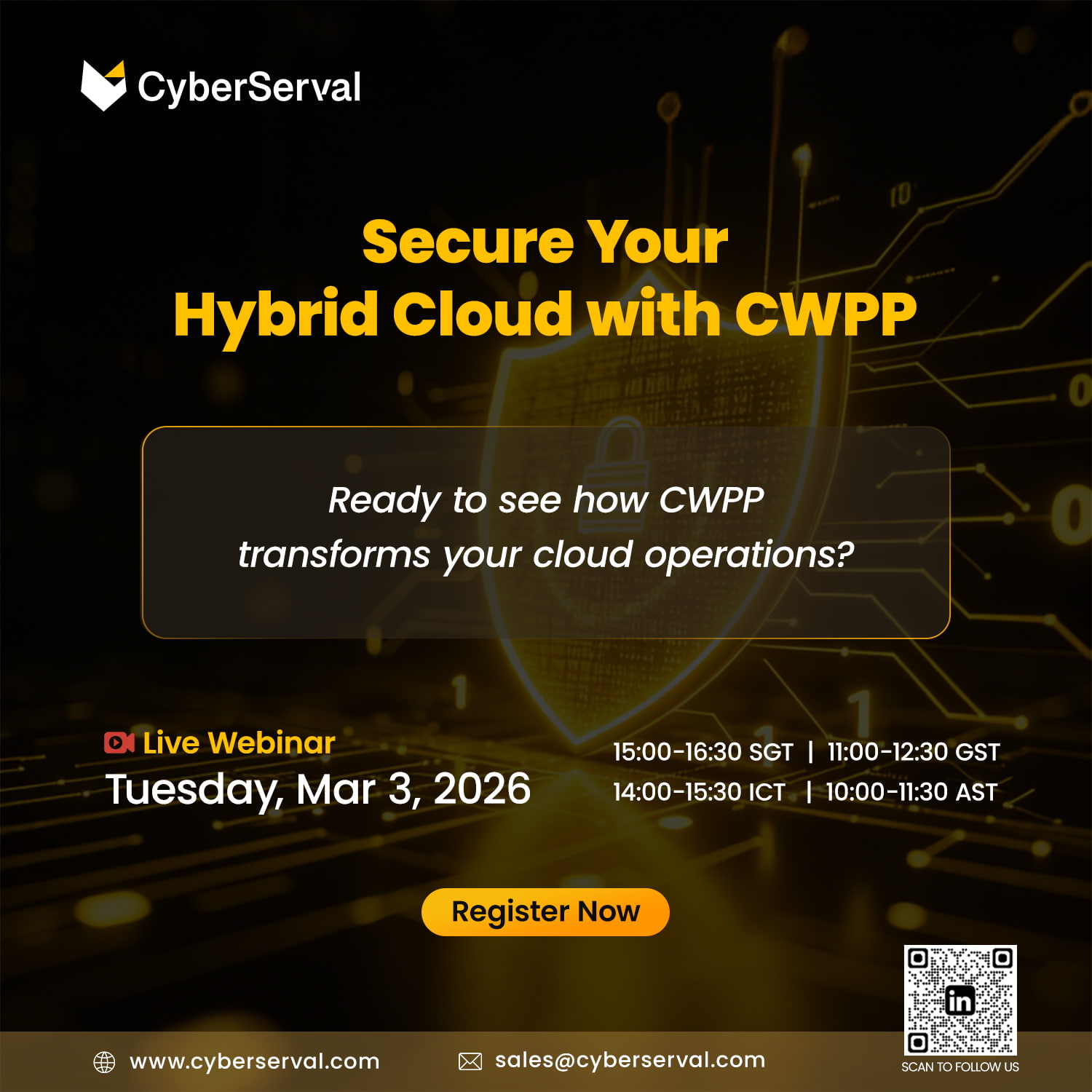
In our upcoming webinar, We will uncover why cloud visibility is still broken and how CyberServal CWPP covers every blind spots.
🔗 [Webinar Recap]
Tuesday, Mar 3, 2026
15:00-16:30 SGT | 11:00-12:30 GST
14:00-15:30 ICT | 10:00-11:30 AST
Live Q&A, bring your toughest questions
👉Get a Chance to Win Amazon eGift Card.