
 Back to Blog
What is OpenClaw and What CISOs Need to Know?
OpenClaw is an open-source, self-hosted AI agent that functions as a "digital butler," capable of executing system commands, managing files, and controlling browsers via natural language. Unlike traditional chat-based LLMs, its core value lies in its autonomous execution. However, this high-level system access introduces severe risks: from gateway authorization bypass and the "ClawJacked" remote control vulnerability to Shadow IT concerns where employees bypass corporate bans. For organizations in the SEA and MEA regions, a simple "block everything" approach is ineffective. Instead, a three-layer defense model integrating Endpoint Detection (DDR), Server Scanning (CWPP), and Network Monitoring (NDR) is essential to ensure visibility, least privilege, and compliance.
What is OpenClaw and Why Did It Go Viral in Months?
OpenClaw has rapidly climbed GitHub star charts, marking a paradigm shift from "Conversational AI" to "Executable AI."
The Power of Execution: While traditional LLMs give advice, OpenClaw acts. It connects LLMs to your local system, allowing users to send instructions via Telegram or Discord to run scripts, automate web workflows, and manage local files.
Rapid Growth: Its viral nature stems from its 24/7 automation capabilities. It can monitor server metrics, summarize emails, and even access paired mobile device cameras or locations to complete multi-step tasks end-to-end.
The Self-Hosted Allure: Being open-source and self-hosted allows developers to keep interaction history local. However, this "privacy" feature often bypasses centralized enterprise security audits, leading to the rise of Shadow IT.
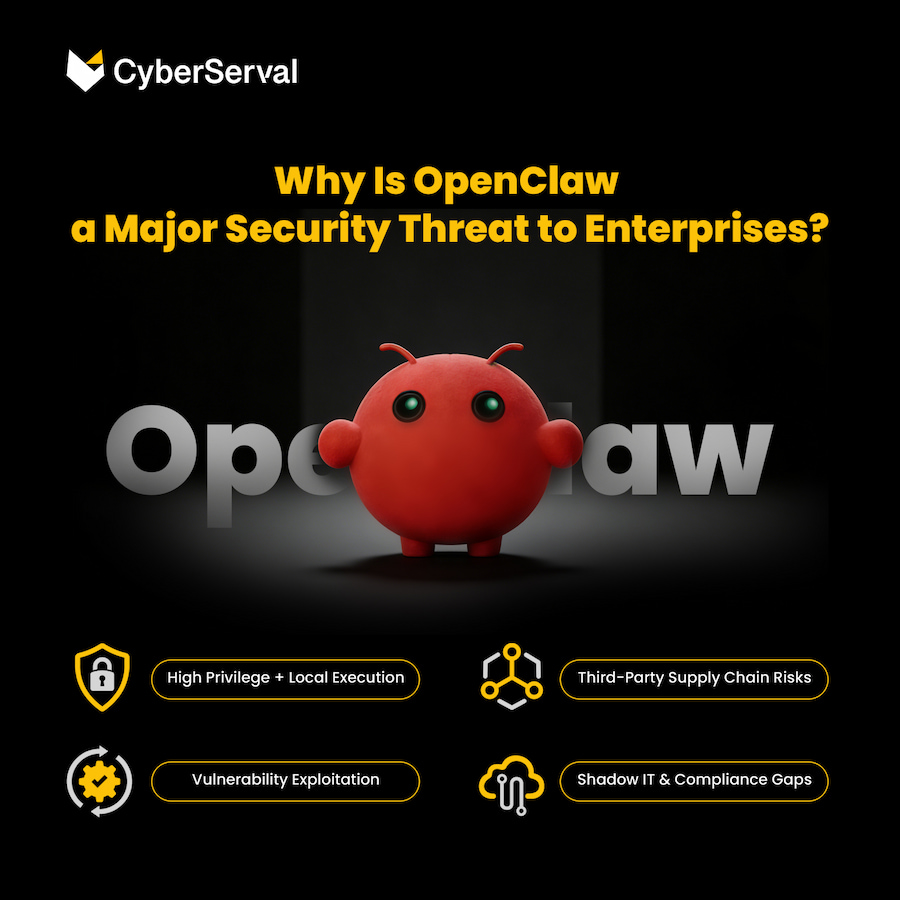
Why Is OpenClaw a Major Security Threat to Enterprises?
The transition from a chatbot to a system-level agent creates a new attack surface where "prompt risks" escalate into "system risks."
High Privilege + Local Execution: OpenClaw requires high-level permissions to function. Without strict sandboxing or auditing, a malicious prompt or a "hallucination" can lead to mass file deletion or unauthorized data exfiltration.
Third-Party Supply Chain Risks: The "Skills" or plugin ecosystem allows execution of third-party code. These components often lack rigorous security vetting, potentially acting as backdoors for attackers.
Vulnerability Exploitation:Gateway Bypass: A bug in the Gateway component can cause it to misidentify external visitors as internal, allowing unauthorized command execution.ClawJacked: A critical remote control vulnerability where simply clicking a malicious link can silently modify OpenClaw configurations, handing total system control to an attacker.
Shadow IT & Compliance Gaps: Employees often install OpenClaw on work devices despite corporate bans (e.g., Meta's restrictions). This creates a visibility vacuum, lacking logs, traceability, and asset oversight—critical for government and financial sectors.
Why “Block Everything” Does Not Work in SEA & MEA
In the fast-growing digital economies of Southeast Asia and the Middle East, rigid bans are often counterproductive.
Innovation vs. Security: Overly restrictive policies drive AI usage underground, increasing risk rather than mitigating it.
Governance Language: Instead of a "hard block," experts recommend shifting to a governance model focused on Asset Visibility, Least Privilege, and Tiered Control. Security must be an enabler of safe AI adoption, not a barrier.
A Three-Layer Defense Model for OpenClaw Exposure
To effectively manage the risks of OpenClaw and similar AI agents, enterprises should adopt a multi-dimensional security strategy:
Endpoint Layer: Detection & Compliance (DDR)
Utilize CyberServal DDR, Next-gen DLP system (supporting macOS, Windows, and Linux) to regain control over employee devices.
Asset Discovery: One-click detection to identify if OpenClaw or derivative frameworks are installed.
Plugin Management: Centrally disable high-risk browser extensions like "Clawdbot Browser Relay" to prevent unauthorized browser manipulation.
Outbound Control: Block file exfiltration through third-party messaging integrations.
Server Layer: Deep Scanning (CWPP)
For production environments and VPS deployments, CyberServal cloud workload protection platforms CWPP provides deep-seated visibility.
Deep Identification: Scan for hidden OpenClaw instances, including Gateway components, Agent processes, and Skill market clients.
Configuration Hardening: Identify weak configurations or legacy vulnerabilities in custom-built AI agents before they are exploited.

Network Layer: Traffic-Side Monitoring (NDR)
CyberServal NDR - network detection and response offers a non-intrusive way to hunt for active AI agents.
Passive Detection: Locate active OpenClaw services within the internal network without requiring agent installation on every asset.
Encrypted Threat Hunting: Use AI-driven behavioral analysis to detect encrypted reverse shells or covert tunnels (ICMP/DNS/HTTP) that AI agents might accidentally or maliciously open.
OpenClaw represents a significant leap in productivity, but its "system-level" nature demands a new security mindset. From the "ClawJacked" vulnerability to Shadow IT risks, the threat is real. By implementing a structured defense model—moving from endpoint visibility to network-side behavioral analysis—organizations can embrace AI innovation without compromising their data integrity.
Is your organization exposed to unauthorized AI agents? Talk to our team today about assessing your OpenClaw exposure and building a resilient AI security framework.
Common Questions About OpenClaw Security
Experts recommend running it in a strictly isolated sandbox or a dedicated VM. Never expose the Gateway directly to the public internet and always use the latest patched version.