
 Back to Blog
How Can Cyberserval DDR Protect Corporate Data from Shadow AI Leaks?
Enterprises today face a silent but massive security threat: Shadow AI. As employees flock to unauthorized generative AI tools to boost productivity, traditional Data Loss Prevention (DLP) systems fail to catch the subtle, context-dependent leaks happening via chat prompts. Cyberserval Data Detection and Response (DDR) solves this by merging advanced LLM-based semantic understanding with kernel-level monitoring. By replacing rigid keyword matching with dynamic context analysis, Cyberserval DDR tracks the full-chain data flow across browsers and endpoints, enabling real-time precision blocking without draining system resources.
Why Do Traditional DLPs Fail to Prevent Shadow AI Leaks?
Traditional Data Loss Prevention (DLP) frameworks rely heavily on regular expressions (regex), predefined keywords, and static file hashes. While this approach works for structured data like credit card numbers, it completely falls apart in the era of generative AI.
When employees interact with Shadow AI platforms, data leaks rarely happen through obvious file transfers. Instead, sensitive source code, intellectual property, or financial forecasts are pasted directly into chat bars, often rewritten or summarized.
Because old-school DLPs cannot interpret the underlying intent or context of a prompt, they suffer from high false-positive rates that disrupt daily operations, or worse, critical false-negatives that leave the enterprise exposed.
How Does LLM-Based AI Content Insight Redefine Data Protection?
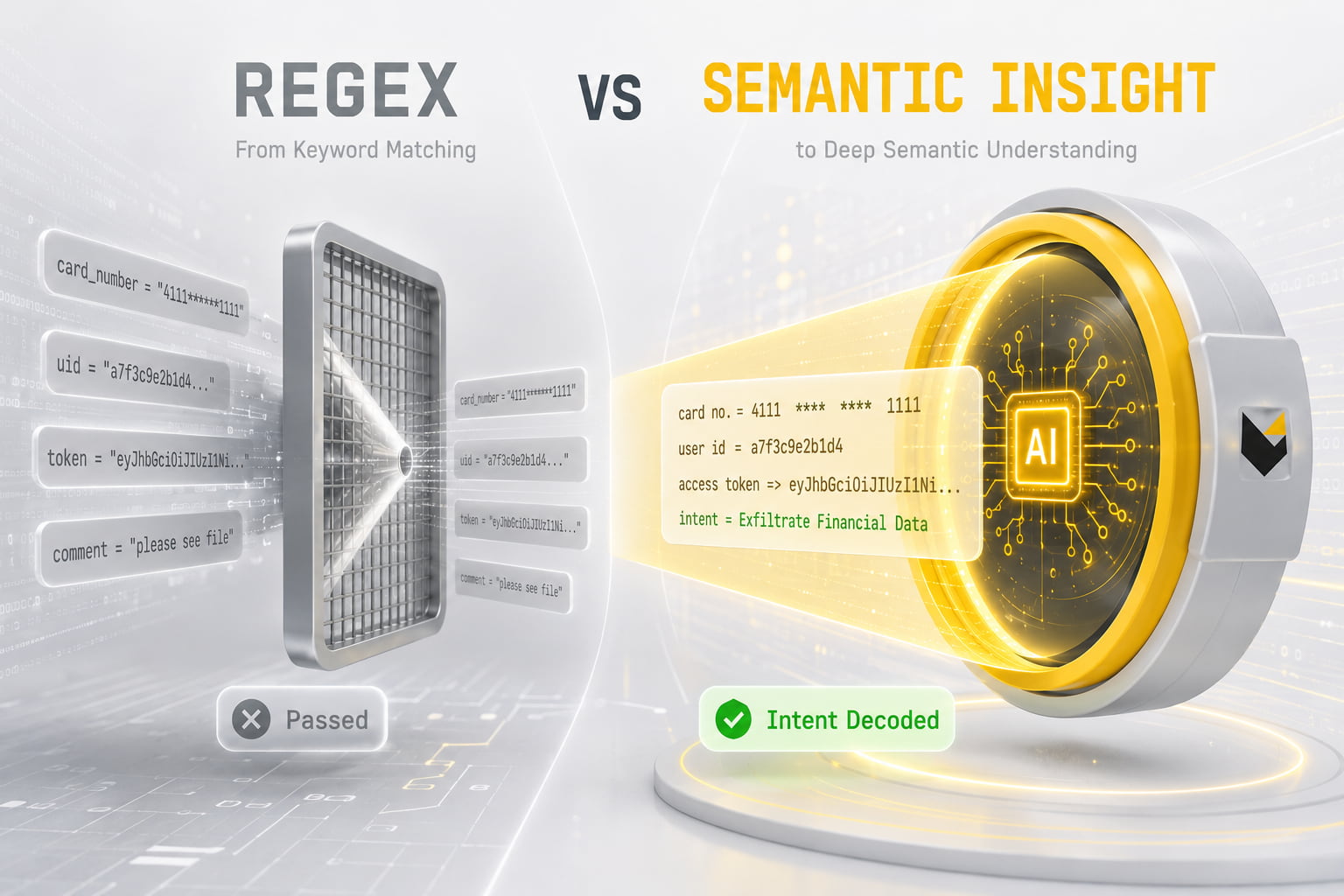
At the core of Cyberserval DDR is a paradigm shift from keyword matching to deep semantic understanding. By utilizing advanced LLM-based engines, the system analyzes unstructured data at a conceptual level.
- Deep Semantic Understanding: The system captures the subtle, nuanced relationships within text, evaluating the actual meaning of an employee's prompt rather than looking for specific blacklisted terms.
- No Keyword Reliance: Even if an employee strips formatting, rephrases a internal document, or translates proprietary code before feeding it into an AI tool, the AI insight engine recognizes the underlying data patterns.
- Dynamic Context Adaptation: The security policies adapt dynamically based on the ongoing interaction, significantly reducing false positives while eliminating blind spots in complex AI conversational loops.
👉 𝗗𝗼𝘄𝗻𝗹𝗼𝗮𝗱 𝘁𝗵𝗲 𝘄𝗵𝗶𝘁𝗲𝗽𝗮𝗽𝗲𝗿 𝗮𝗻𝗱 𝗽𝗿𝗲𝗽𝗮𝗿𝗲 𝘆𝗼𝘂𝗿 𝗱𝗮𝘁𝗮 𝘀𝗲𝗰𝘂𝗿𝗶𝘁𝘆 𝗳𝗼𝗿 𝗚𝗲𝗻𝗔𝗜
What Is Full-Chain Data Flow Tracking for Shadow AI?
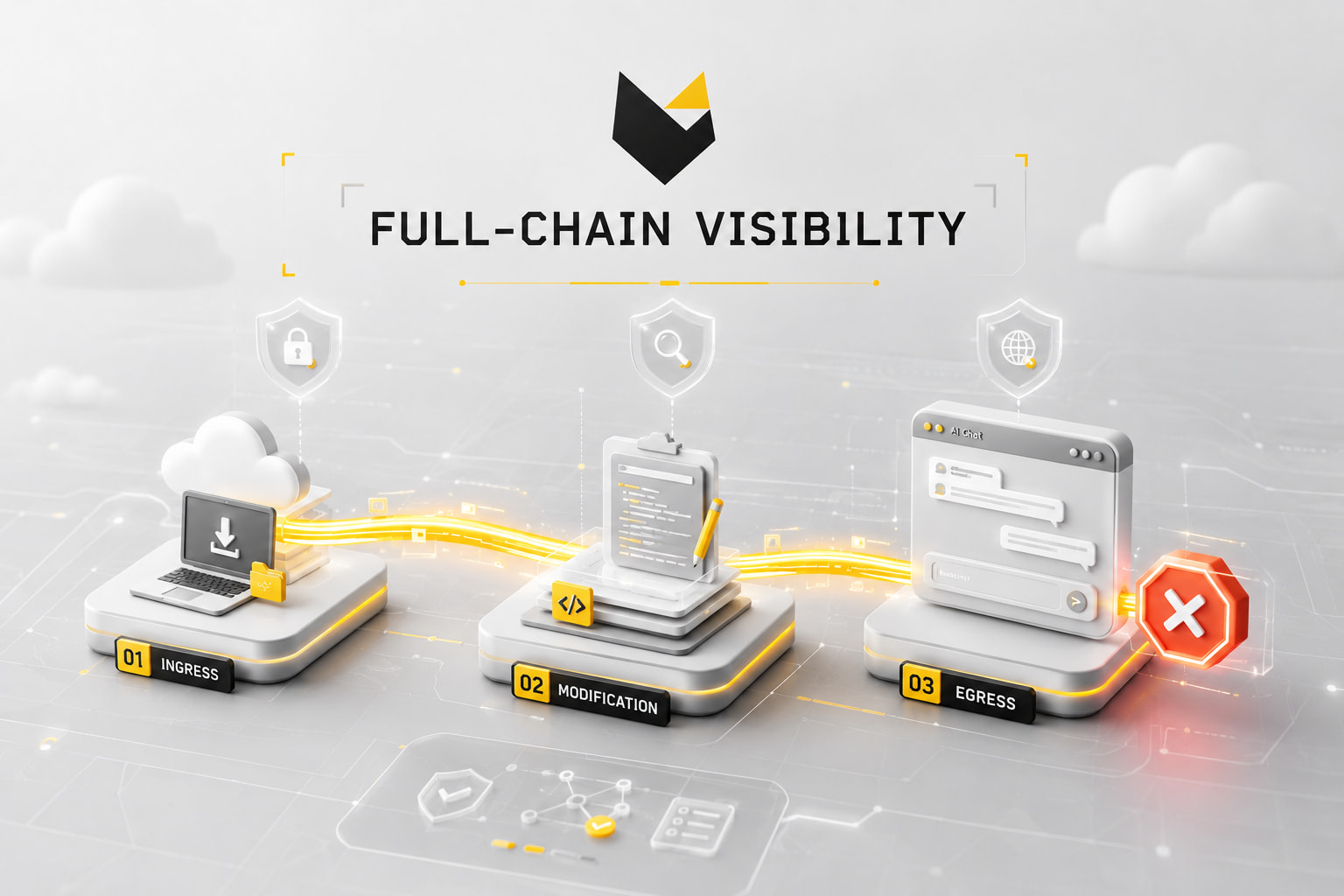
Data leakage into Shadow AI platforms is rarely a single, isolated event; it is usually the final step in a multi-stage data movement chain. Cyberserval next-gen DLP implements Full-Chain Data Flow Tracking to give security teams total visibility over these pathways.
| Phase | User Action | Cyberserval DDR Visibility |
| Ingress | Downloading proprietary code or docs | Tracks original source, timestamps, and user intent |
| Modification | Editing, renaming, or local copy-pasting | Monitors local clipboard and processing activity |
| Egress | Uploading or pasting into a browser AI tool | Catches the exfiltration attempt at the endpoint level This end-to-end monitoring ensures that whether data moves through web browsers, instant messaging applications, or local clipboards, administrators can trace the entire behavioral lineage—knowing exactly where the data came from, how it was modified, and where it was headed. |
How Does Cyberserval Deliver Real-Time, Granular Control Across Browsers?
Detection is only half the battle; stopping the leak before it hits public AI servers is where execution matters. Cyberserval DDR utilizes kernel-level driver monitoring to achieve sub-second mitigation.
Second-Level Interception
By operating at the operating system kernel level, the system detects sensitive data payload attempts instantly. If a user attempts to paste restricted IP into a web-based AI prompt, Cyberserval triggers a sub-second cutoff, blocking the transmission entirely.
Tailored Policy Responses
Enterprises do not have to rely on a blunt "block all" approach. Security teams can configure granular, risk-adjusted responses based on data classification:
- Ignore / Audit: For low-risk queries, log the event for review without interrupting the user.
- Pop-up Warning: Prompt the user with a policy reminder before allowing transmission.
- Block / Approval: Immediately freeze the action and require manager override for highly sensitive data.
Dedicated Browser Optimization
Since most Shadow AI tools are accessed via standard browsers (B/S architecture), Cyberserval enforces rigid controls over web vectors. It fully covers multiple key nodes in the browser's outbound process, such as manages file uploads, downloads, URL access, and clipboard copy-paste mechanics to insulate corporate data.
How Does Cyberserval Resolve the Performance Bottlenecks of Legacy DLP?
Deep content analysis typically demands heavy computational power, leading to sluggish endpoints and frustrated employees. Cyberserval DDR overcomes this performance wall through optimization engineered for modern enterprise scale.
- Ultra-Lightweight Agent: The endpoint installation package is under 30MB, and steady-state CPU utilization remains below 3%. Employees experience zero system lag during deep semantic scans.
- 10x Faster Detection Rates: Compared to traditional solutions processing large datasets, Cyberserval's processing engine supports tens of thousands of terminals online simultaneously, as well as simultaneous detection, etc.
Transform Shadow AI into a Secure Workspace
Cyberserval DDR flips the script on enterprise AI security. By fusing LLM-driven semantic recognition with deep kernel-level monitoring, it effectively transforms "uncontrolled shadow channels" into visible, fully managed safe zones. Enterprises no longer have to choose between cutting-edge AI productivity and strict data governance.
Ready to secure your data? Contact our security team today to schedule a demo of Cyberserval DDR and discover how to gain complete visibility over your organization's AI data flows.
Frequently Asked Questions
No. Because the endpoint agent is ultra-lightweight (under 30MB, <3% CPU), and boasts a 10x faster processing speed for large code files, developers will not experience latency or computer freezing during compilation or authorized prompt tasks.