

 Back to Blog
How Did a Major Financial Institution Protect Complex Multi-Zone Web Assets?
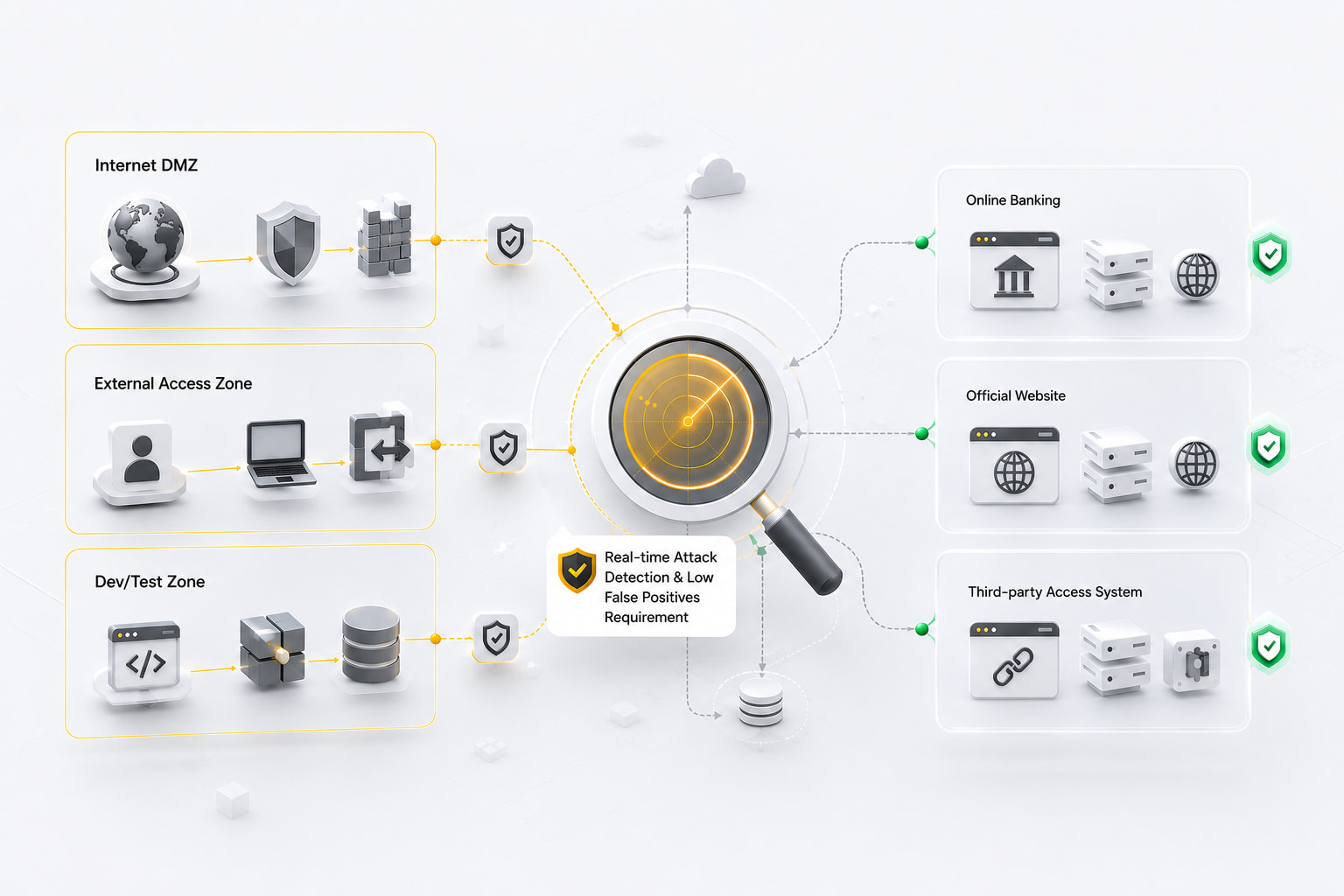
A leading national financial institution, managing an intricate infrastructure of online banking platforms, official web portals, and third-party partner integration systems, faced the critical task of scaling its web application security. The organization's diverse digital footprint spanned across multiple segregated network layers, including the Internet DMZ, external access zones, and dedicated development or testing environments.
With an expansive volume of web assets running on a highly intricate network architecture, the institution required continuous, real-time threat detection and mitigation across all business systems. However, maintaining strict business continuity was a primary concern; the security operations team could not tolerate excessive false blocks that might disrupt legitimate financial transactions. Furthermore, the complexity of day-to-day administrative tasks, combined with limited personnel bandwidth, made granular, manual security policy tuning across individual standalone appliances made granular manual tuning impractical given limited staff bandwidth.
Why Do Legacy Egress Protections Struggle in High-Throughput Financial Networks?
Modern financial infrastructures demand high availability and low latency, rendering traditional inline Web Application Firewall (WAF) models highly problematic when deployed at scale. The friction between rigorous security enforcement and infrastructure stability surfaces across several operational dimensions.
How Does CyberServal WAF Combine Out-of-Band Inspection with Centralized Management?
To eliminate these structural vulnerabilities without altering the underlying network fabric, the institution implemented a comprehensive egress protection architecture powered by CyberServal NGWAF. The solution engineered a out-of-band mirroring architecture, highly scalable detection fabric distributed across major data center hubs.
High-Throughput Out-of-Band Traffic Inspection
To eliminate inline operational risks, the deployment leverages a non-intrusive, out-of-path monitoring mode.
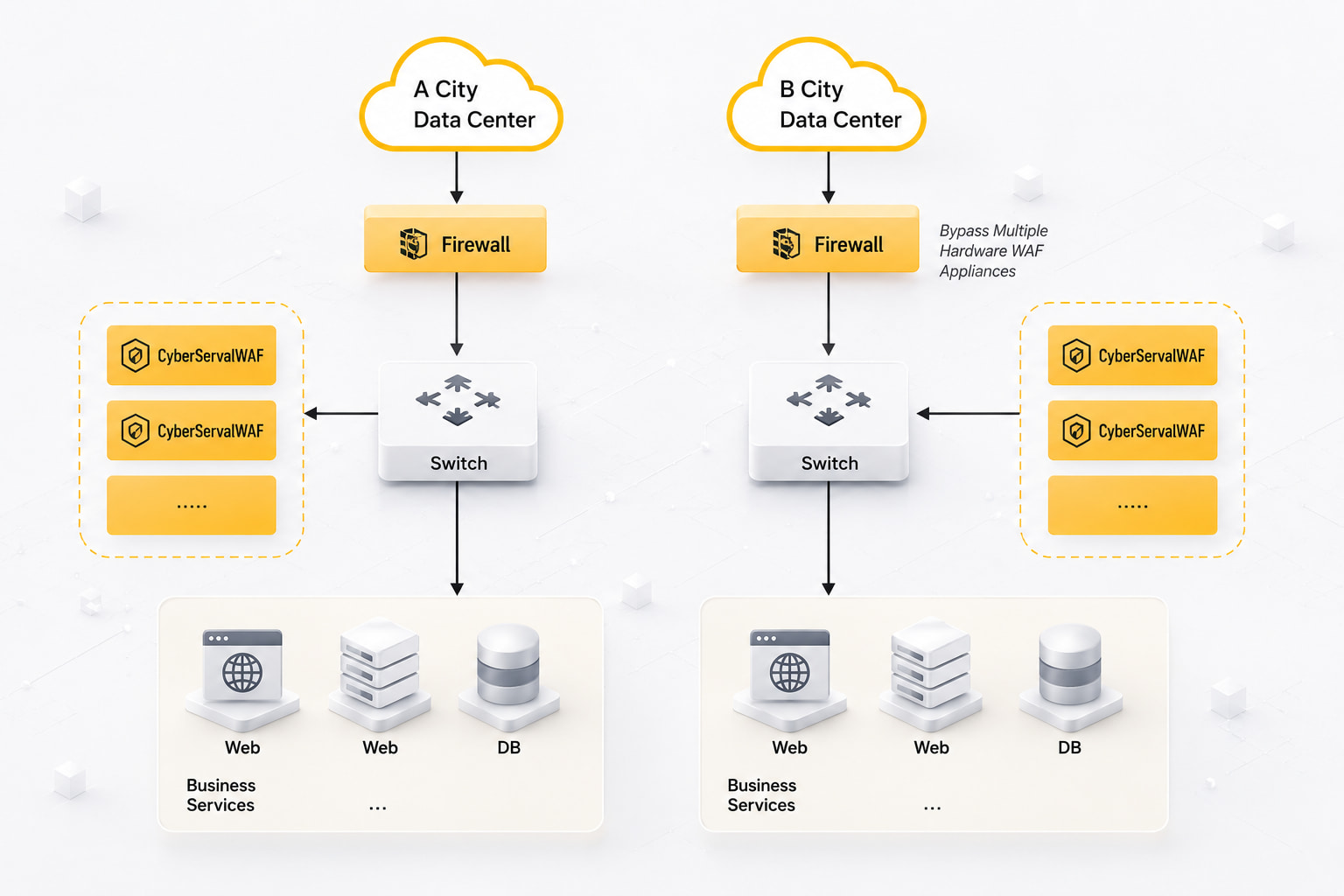
- Decryption Offloading: Live production traffic entering the head office data centers first passes through a dedicated SSL offloading device.
- Parallel Mirroring: The decrypted traffic is mirrored directly to an array of clustered CyberServal WAF hardware appliances. This out-of-band architecture guarantees that the threat detection process operates independently of the primary transaction path, is designed to operate independently of live financial services from any potential latency or processing bottlenecks.
Scalable Hardware Clustering across Dual Data Centers
To process massive transaction volumes safely, the architecture relies on a clustered hardware topology distributed across active data centers in 2 cities.
- Load Distribution: High-volume traffic is dynamically distributed across the clustered hardware appliances to prevent resource saturation.
- Comprehensive Coverage: The inspection perimeter spans the complete ingress fabric, covering the Internet zone (including external web and application layers), external DMZ zones, and critical branch uplinks such as group access points and network zone ingresses.
Centralized Management Platform
Operational complexity is managed via a unified administrative layer.
- Unified Policy Synchronization: Rather than modifying rules on an appliance-by-appliance basis, engineers use a centralized management platform to orchestrate defense baselines across all active clusters.
- Operational Efficiency: Global security policies, whitelist exceptions, and custom signature controls are updated from a single console, drastically reducing day-to-day administrative overhead and addressing staff bandwidth limitations.
Related Article: How a Mega-Bank Lowered Operational Risk via a Centralized WAF Platform
Delivering Low-Intrusiveness Security with 60G Peak Capacity
The deployment of CyberServal WAF achieved immediate, measurable improvements in infrastructure resilience and operational efficiency:
- Zero Network Disruption: Because the out-of-path mirroring mode required no structural modifications to user networks, server topologies, or client-side application configurations, the institution achieved an exceptionally short go-live cycle.
- Proven High Throughput: The hardware cluster architecture successfully processes production peak traffic exceeding 60G, maintaining continuous, stable operations across all primary web applications.
- Automated Incident Response: The WAF engine provides native, automated log integration directly with the enterprise Security Information and Event Management (SIEM) platform. Real-time threat data flows continuously into the SIEM pipeline, meets requirements for automated response and enabling timely, automated security responses.
- 👉 Book a Demo today