

 Back to Blog
Fast Decision-Making with CyberServal DDR Real-Time Data Visualization
What is the Core Mechanism of CyberServal DDR for Rapid Decision-Making?
In modern enterprise environments, data security incidents propagate within seconds, rendering traditional, reactive data loss prevention (DLP) methods obsolete. CyberServal Data Detection and Response (DDR) redefines incident response by transforming massive volumes of unstructured log data into an intuitive, actionable, and real-time visual infrastructure. CyberServal DDR enables faster decision-making by replacing static keyword-matching alerts with an AI-driven, real-time "Data Asset Map" and comprehensive behavioral lineage tracking, allowing security teams to instantly pinpoint high-risk anomalies, trace data origins, and execute kernel-level mitigation within sub-seconds.
By synthesizing endpoint telemetry, network activities, and deep content analysis into a unified dashboard, administrators do not have to waste hours manually parsing disjointed system logs. Instead, the system delivers structured visual telemetry that answers who, what, when, and where a risk occurs. This immediate contextual clarity bridges the gap between threat discovery and containment, empowering security operations centers (SOC) to transition from delayed investigations to instantaneous, data-driven security orchestration.
How Does the Visual Data Asset Map Accelerate Risk Identification?
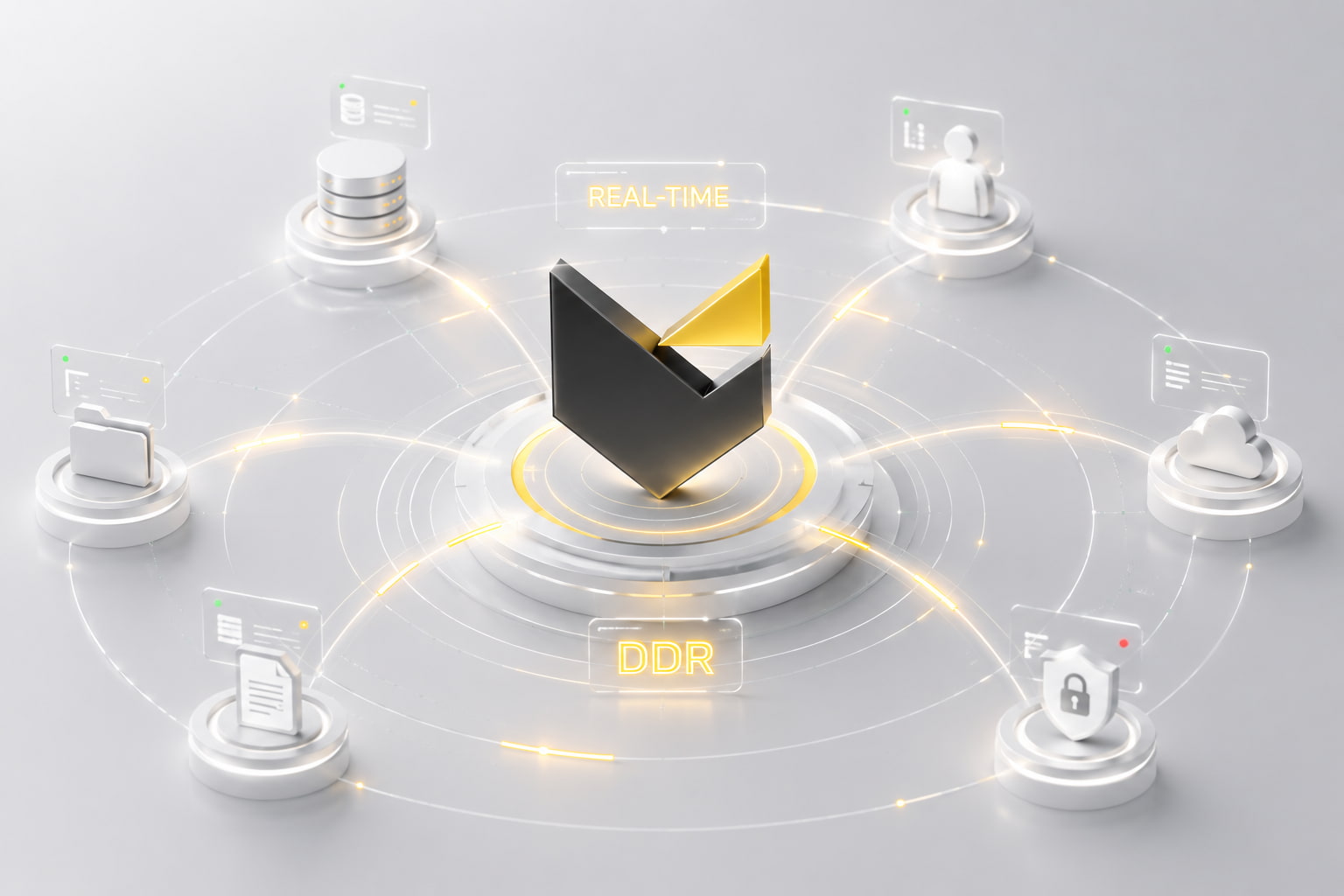
Effective data protection is fundamentally impossible without complete situational awareness. CyberServal DDR addresses this challenge through its automated asset discovery engine, which visually aggregates data distribution across the entire enterprise office domain into a dynamic Data Asset Map.
Instead of relying on manual classification, the system employs automated Machine Learning pipelines: utilizing Bidirectional LSTM and Conditional Random Fields (CRF) alongside word-graph automata for high-speed tokenization and Named Entity Recognition (NER), followed by Gaussian Mixture Models (GMM) to automatically cluster patterns and generate baseline security rules for unstructured files.
The visual interface accelerates administrative assessment through three core design methodologies:
- High-Level Executive Aggregation: Security managers can oversee compliance posture and data exposure levels at a glance without navigating complex permission trees or manual spreadsheets.
- Granular Business-Centric Filtering: Data assets are visually sorted by risk tier, business department, file size, and timestamp, mapping security vulnerabilities directly to operational units.
- Real-Time Label Integration: Metadata and asset sensitivity labels are seamlessly fed into downstream tracking modules, providing immediate context when an anomalous outbound transmission is detected.
Why is Full-Chain Data Flow Tracking Crucial for Quick Forensic Analysis?
When a data breach occurs, security analysts typically spend days reconstructing the timeline. CyberServal DDR eliminates this investigative friction via Full-Chain Data Flow Tracking, capturing the entire lifetime behavior of an asset from ingress to egress. Data leakage is rarely an isolated action; it is a multi-stage process where information is manipulated before exfiltration.
The visual forensics tracking panel displays this lineage chronologically, dividing employee actions into three distinct visibility phases:
| Phase | User Action Tracked | CyberServal DDR Visual Visibility | Decision-Making Impact |
| Ingress | Downloading source code, legal contracts, or financial reports. | Logs original source, precise timestamps, and explicit user intent profiles. | Establishes the baseline legitimacy of data access. |
| Modification | Local copy-pasting, renaming files, changing suffixes, or compressing folders. | Monitors the local clipboard, OS registries, and ongoing processing activity. | Exposes evasion tactics used to bypass traditional signature scanners. |
| Egress | Uploading or pasting payloads into browser-based Shadow AI tools or IM apps. | Identifies endpoint-level exfiltration pathways via SSL-decrypted web traffic. | Signals immediate policy violation for real-time containment. Through this comprehensive behavioral tracking matrix, managers instantly identify whether a file uploaded to a public AI platform was an accidental paste or part of a coordinated insider threat pattern. |
How Do Real-Time Kernel Metrics Enable Sub-Second Mitigation Decisions?
Visual alerting is only as valuable as the execution speed it enables. To prevent a data packet from reaching unauthorized external servers, CyberServal DDR utilizes a hybrid kernel monitoring architecture that combines OS-native security callbacks with a proprietary, patented Kernel Inline Hooking Mechanism. Operating at the core operating system level across Windows, macOS, and Linux, this technology bypasses the latency of standard user-mode applications.
When a user attempts a risky operation—such as pasting sensitive intellectual property into a public LLM prompt—the kernel-level agent intercepts the application's API call instantaneously. Rather than forcing a global, rigid block strategy that hurts employee productivity, CyberServal's Dynamic Decision Center interprets the real-time risk score and instantly presents tailored policy responses:
- Ignore / Audit: Low-risk operations are silently logged for periodic operational analysis without disrupting user workflows.
- Pop-up Warning: Borderline behaviors trigger immediate visual alerts to educate the employee and verify intent.
- Block & Approval: High-risk exfiltration attempts are blocked in less than a second (sub-second mitigation), and the system automatically forwards an emergency approval request to managers.
Actionable Security Visibility
CyberServal DDR bridges the critical gap between massive data visibility and rapid operational response. By transforming unstructured endpoint logs into a clear, interactive visual asset infrastructure, it empowers modern enterprises to easily outpace evolving threat vectors. Security leaders can confidently identify anomalies, trace end-to-end data lineages, and orchestrate sub-second mitigation at the kernel layer.
If your organization is looking to eliminate blind spots in conversational AI loops and accelerate incident response times, it is time to upgrade your digital architecture. Contact the CyberServal security team today to schedule a live DDR demo and achieve complete visibility over your enterprise data flows.
Frequently Asked Questions
CyberServal DDR integrates Browser Data Loss Prevention (BDLP) technology directly into browser runtimes. By combining precise data matching techniques with multi-dimensional aggregation, it intercepts, decrypts, and evaluates SSL-encrypted web traffic and URL file uploads without requiring heavy network proxies or disrupting the user experience.